Salary
Q "Divulging salary history"
I am in the process of looking for a new job. One of the things I frequently see in
various advertisements is a request for salary history. I am hesitant to give out my
salary history because I am looking for an increase in salary. Also, I am not sure how to
include salary history. If I provide a prospective employer with this info, do I include
it on my resume or in the cover letter?
A You've brought up one of the more serious flaws in the Employment System.
Employers have no business asking for your salary
history. It's confidential. It has nothing to do with hiring you. Imagine what they'd say
if you asked to see the history of salaries they've paid for this job over the past ten
years. Or, if you were to ask the manager what his current salary is. Sorry, Mr.
Manager, but what's good for the goose is good for the gander.
The excuse employers make is that your past salary helps
them determine your experience level, it pegs your value, and it helps them establish a
new salary for you.
Hogwash. By that logic, they don't need to interview you.
All they need is your salary history and you're off to the races. By using the figures
other employers have used, they'll know what their job is worth and what you are worth.
And they'll win the lottery, too.
Salary is a judgment of value. It's incumbent on
an employer to figure out what the job he wants done is worth, quite apart from who you
are, what you've done, or what you've been paid before. In the interview, the employer
factors in his judgment of how you would contribute to the success of that job. That's how
an offer should be derived. It shouldn't matter what you were making at your last job,
especially in a world where 17-year-olds who were earning five bucks an hour flipping
burgers last year are earning $40k this year designing web pages, and where $100k
executives are seeking $50k sales jobs.
Bottom line: when you divulge your salary history, you
put yourself in a corner that's very difficult to negotiate your way out of.
Here are my suggestions about how to deal with the
"salary history" problem...
Learn how to stop employers from using your old salary to put a cap on your new job offer...
 |
You've just read a short selection of the
most widely-acclaimed Answer Kit on
Ask The Headhunter!
Now read the complete
Ask The Headhunter Answer Kit:
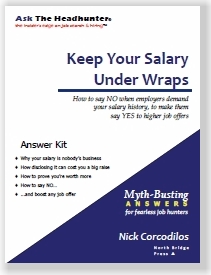
Keep Your Salary
Under Wraps |
Myth-Busting Answers For Fearless Job Hunters:
- Who says your salary history is anybody's business?
- Why does HR really want to know what you get paid?
- Can disclosing your salary cost you a big raise?
- How can you say NO... and get the best possible offer?
Don't let your old salary "cap" your new job offer!
- 24 pages of insights and insider tips that expose, explain, and counter the methods employers use to control salary negotiations and minimize job offers.
- Learn how to say NO to demands for your salary history, politely and with authority.
- Prove your value, to get hired at the highest possible salary.
Keep Your Salary Under Wraps
LEARN MORE!
| "I
love Nick's new Keep Your Salary Under Wraps.
It worked for me. Nick gave me the same advice
that's in the book when I was negotiating a job
offer several years ago. Despite both the headhunter
and the company insisting I disclose what I was
getting paid at my old job, I stuck to my guns and I
was able to double my salary. Plus I got a signing
bonus. That would have never happened in a million
years if I had caved!"
--
Bernie Dietz
|
|
The contents of this site are Copyright (c)
1995-2015 North Bridge Group LLC.
All rights reserved.
This material is for personal use only. Republication and redissemination,
including posting to news groups, is expressly prohibited without prior written consent.
Ask The Headhunter, Fearless Job Hunting, the ATH logo and other ATH titles are trademarks or registered trademarks of North Bridge
Group LLC and
Nick A. Corcodilos. |
User
agreement, legal information and disclaimer. |
|