|
|
Resign Yourself To
Resigning Right
By Nick Corcodilos |
Part 1
Lots of people are getting new jobs this year. With each
of these job changes comes a very difficult chore: resigning from the old job. Tendering a
resignation and doing it properly is an onerous task. It is awkward to resign, and some
people just don't know how to do it properly. But some folks are so clever about it that
they outsmart themselves.
Before discussing how to resign, let's look at a couple
of examples of how not to do it. First, a horror story about what can happen when an
opportunist tries to use his resignation as a threat. Then, how being
afraid to say goodbye to his boss almost ruined a young
engineer's career...
This
article has been truncated...
|
Headhunter Nick Corcodilos's acclaimed
Resign Yourself To Resigning Right
is revised and expanded,
and
is now a section of Nick's PDF book:
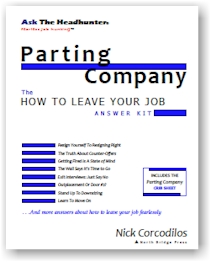
Parting
Company | How to leave your job
It's
the must-have Answer Kit you need to make your
next move on your own terms... fearlessly.
Don't
put your future at risk!
Do you know the 5 Rules of Resigning Right?
-
Don't
jump the gun:
Know exactly the right way to resign!
-
What's
the one key decision you must make before you resign?
-
Have
you calculated
the
value of your resignation?
-
Do
you know how to avoid disaster
after a resignation?
-
How
you depart
determines
how you wind up!
|
This
73-page PDF book is packed with Nick's insider advice,
including:
-
Resign
Yourself To Resigning Right
-
The Truth
About Counter-Offers
-
Getting Fired
Is A State of Mind
-
The Wall Says
It's Time to Go
-
Exit
Interviews: Just Say No
-
Outplacement
Or Door #2?
-
Stand Up To
Downsizing
-
Learn To Move
On
-
Plus
The Parting Company Crib Sheet:
Insider
tips from Nick's favorite HR experts about how
to avoid unnecessary
risks when you leave any job.
-
Plus
How to succeed at your next job!
+
Panic
Attack: Your first day on the job
+
Start
A Job On The Right Foot
And...
more answers
about
how to leave your job fearlessly!
|
Nick
Corcodilos charges hundreds of dollars for a private Talk
To Nick coaching session. For a fraction of
that, you can profit from 73 pages of Nick's
acclaimed insider advice about
how to change jobs on your own terms... delivered
in Parting
Company in the same no-punches-pulled
conversational style he's known for. No matter why you're leaving
your job -- get Nick's easy-to-understand advice about how to do it on your own
terms! |
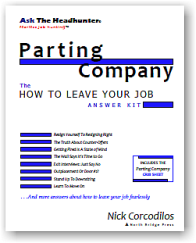
Parting
Company | How to leave your job
Whether
you're leaving a job voluntarily, getting fired, getting
downsized, or quitting for any reason...
Don't panic or blow it when
Parting
Company!
Can you afford not to know how to leave your job?
Get
the Ask The Headhunter edge now!
|
Notes
from
the
Ask The Headhunter community
"This is like reading a high-priced consultant's report to discover the "BFO" (blinding flash of the obvious). A lot of what you write makes absolute sense. It's intuitive (dare I say innate) and yet so many of us continue to follow traditional HR dogma when searching for work. Shame."
Bill Hiltz
"The great news about your recommendations is that they work. The good news for those of us who use them is that few people are really willing to implement what you recommend, giving those of us who do an edge."
Ray Stoddard
"I read your columns and have bought your book (and read it several times). It sits on my desk to refer to. It changed the way I look at job hunting 180 degrees! I recommend it to everyone who has need of it (and most have bought it!). If you do a sequel, I will buy that one, too."
Bill Cartwright
"Nick, you probably know that you are the one writer in the country (or the world) that I never disagree with. You hit all the notes that I have been crying 'alarm' about since 1970 myself. You are uncannily on target, all the time. God bless your work, as always."
Dick Bolles, Author, What Color Is Your Parachute?
"Nick... what can I do but join the teeming throngs of folks chanting your praises? No-BS, tell-it-like-it-is folks like you are too damned rare. I'm emailing you to say
thanks. You are my new hero."
Mary Lee Chapman
"Just a note to let you know that your job seeking advice is pure gold. Nice to see somebody cut through the morass with intelligence."
Gary Deines
"I am a retired USAF officer who just got furloughed out of four years with Northwest Airlines. I feel like I have just cut through a thunderstorm and found smooth air and bright sunshine on the other side. Thanks!"
Jack Elliott
"I like your no-nonsense approach to the search-related topics you tackle. You are not afraid to go against the grain and shake things up with a dose of reality and responsibility. I LIKE IT!"
Kristie Derkos
|
Take the risk & fear
out of resigning!
Parting Company | How to leave your job
|
The contents of this site are Copyright (c)
1995-2015 North Bridge Group LLC.
All rights reserved.
This material is for personal use only. Republication and redissemination,
including posting to news groups, is expressly prohibited without prior written consent.
Ask The Headhunter, Fearless Job Hunting, the ATH logo and other ATH titles are trademarks or registered trademarks of North Bridge
Group LLC and
Nick A. Corcodilos. |
User
agreement, legal information and disclaimer. |
|