|
|
The
Library Vacation™
By Nick Corcodilos |
Part
1
People often
make the mistake of asking a headhunter, "What new career
should I pursue?" It's important to understand why that
question will lead a headhunter to hang up the phone.
Headhunters rarely
recruit people from one career to another. Headhunters' clients
would never stand for it. A headhunter's clients want the best
people who are already doing a particular kind of work to come do
it for them. Consequently, headhunters usually move people within
a career domain, not outside it.
Nonetheless, when I
offer to let people "ask the headhunter", this question
comes up all the time. (Too often, people ask it after they've
spent thousands of dollars on career counseling.)
Pack
a suitcase for one.
I believe the choice of
a new career is a very personal decision. The best career
counselors might give you some food for thought, but I believe
that the motivation a person needs to tackle such an enormous,
life-altering challenge lies -- almost by definition -- within
himself. The search has to be self-directed. In other words,
you'll never find what you're looking for if you let someone else
point you toward what he thinks you're looking for.
If you want to make a
profound change in your career, you've got to buck up, put on a
sturdy pair of boots, and go searching on your own. There's lots
of philosophizing to do on this subject, but I'd like to suggest
one idea that might help you find your own way to the future.
I call this approach to
career change The Library Vacation™. It's a little corny, it's
very simple (though not easy), and it's so obvious that few people
ever think to do it. It's also incredibly powerful because it is
rooted in who you are.
Destination:
Off the path.
Take at least
three days off and spend them at the library. (A week is better.)
Go into the periodical stacks. Forget about job hunting or
careers. (This is the vacation part.) Read whatever you feel like.
At first, you'll start with magazines like People, Newsweek,
Rolling Stone, foreign newspapers and so on. Then, you'll
start checking out various specialty and industry-related
periodicals. Just read stuff that attracts you.
- The best way to find
a new path is to let your motivation lead you. Leave your
skills, your college degree, your experience and your
credentials behind. You can haul them out later, when you need
them. For now, they're irrelevant.
As you follow your gut,
you'll start to see trends in the sorts of industries and product
areas you're reading about. That will tell you something: this
might be your path...
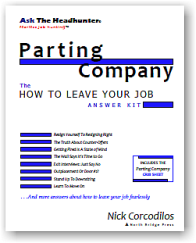
| This
popular article has been revised and
expanded into a full section of Nick's new book, the How
Can I Change Careers? Answer Kit.
Please
click for more information and
to view samples from the book, and to learn how to change
careers successfully using the methods described throughout
Ask The Headhunter.
This
36-page book
includes a crib sheet
to help get your career change on track—and to help you
keep it there!
Check
it out now! |
NOTE: The Library
Vacation is a trademark of North Bridge Group, Inc.
More Headhunter
Articles
The contents of this site are Copyright (c)
1995-2015 North Bridge Group LLC.
All rights reserved.
This material is for personal use only. Republication and redissemination,
including posting to news groups, is expressly prohibited without prior written consent.
Ask The Headhunter, Fearless Job Hunting, the ATH logo and other ATH titles are trademarks or registered trademarks of North Bridge
Group LLC and
Nick A. Corcodilos. |
User
agreement, legal information and disclaimer. |
|