|
 |
ð
Sign up now!
ï
The
Ask The Headhunter Newsletter is HERE!
Get The
Headhunter's advice in your mailbox. |
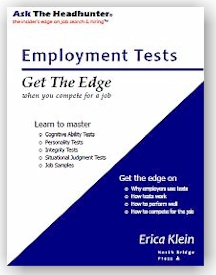
When you are in the running for a job there is a good chance you will be asked to take
some tests. There are things you can do to help make this a win-win situation for both you and the employer. I'm going to give
you a general overview of employment tests, discuss the types of tests you might be asked to take, provide pointers for doing
well in pre-employment testing, and describe how you can come out ahead even if you don't get the job. If you don't feel like
reading that much, here are the top three things to know about pre-employment testing:
- Keep a good attitude during the testing.
- Preparation can help for some types of tests.
- Find out if you are entitled to feedback and get as much as you can.
Now read on for some more detailed information.
The Basics of Employment Testing
Know your tester and know your rights.
The cost of testing a single job candidate can range from $100 to more than $5,000. Employers are making a significant
investment in testing you. Unfortunately, there is virtually no government regulation regarding who can design and administer
employment tests.
Most large human resource consulting firms and some corporations will use
organizational psychologists to develop and perform assessments. Psychologists abide by codes of ethics and guidelines that
ensure tests are reliable and valid, laws forbidding discrimination are scrupulously followed, and test takers are treated with
respect. You can read about psychologists' perspective on The Rights
and Responsibilities of Test Takers on the American Psychological Association's web site. If the assessor is not a
psychologist, he or she is not necessarily bound by a professional code of conduct.
Of course, you could refuse to take a test, and you can also refuse to participate in
any part of any test. This will probably result in being rejected for the job. If you believe that the testing was illegal in
any respect you can pursue legal remedies just as you can for any unfair and illegal employment practice. If you felt the
assessor at any time treated you unfairly or with disrespect, you may want to bring that up with the employer and/or the
assessment firm.
At no time should you be asked any questions about disabilities you may or may not
have; this is illegal under the Americans with Disabilities Act. Questions about sexual orientation, sexual practices, with whom
you live, your religious beliefs or your ethnic background are also inappropriate although not necessarily illegal.
Testing the tests: reliability and validity.
Good testing results in better predictions of job performance but not perfect predictions. A good test is reliable
and valid. Reliable means it works the same each time it is given. Valid means it measures what it is supposed to
measure. A vision test given outdoors would not be reliable if it was given sometimes on bright days and sometimes on cloudy
days. A reading comprehension test would not be valid if it was given to people who read well but in a different language.
A test compares you to the ideal employee.
The principle behind this testing is that the employer has identified the qualities (often called "competencies")
it takes to do well at the job and wants to see to what extent you possess those qualities. It is important to understand that
employers will be comparing your scores to some ideal profile of a good employee in that job. In other words, if you are being
tested for extroversion, analytic ability, communication skills and attention to detail for a customer service job, you are most
likely to get the job if your scores match the profile of an excellent employee in that position, not if you score as
high as possible. In other words, it is possible to be too analytical or too extroverted for a particular job.
This article assumes that an employer is administering an employment test to you in
good faith, and that the test and its interpretation are legitimate. You must use what we have discussed up to this point to
judge whether you want to proceed with an employment test.
Get An Edge on 3 Major Types of Tests
Now let's discuss three of the major categories of tests you might encounter. For each
one, I will offer some suggestions that might help improve your performance.
Intelligence tests.
There are several types of tests you may encounter. Most assessments will include more than one type of test. Intelligence
tests (also known as cognitive ability tests) are part of most pre-employment assessments because intelligence is the best
single predictor of job performance.
The problem with using only an intelligence test is that it can have adverse impact on
protected groups of people. The reasons for this are complex and not entirely understood, but in order to avoid lawsuits and to
increase the predictive power of testing, most employers will use intelligence tests in conjunction with other types of tests.
Intelligence tests could consist of logic problems, word problems, pattern
identification and/or other kinds of questions.
| Get an edge: Unfortunately, there is no way to
significantly improve your performance on intelligence tests other than avoiding anxiety that could impair your performance.
Knowing that is an edge in itself. |
Personality tests.
Personality tests are also very popular with employers. These tests can be very long and will usually ask you to rate
the extent to which a statement applies to you or to select your preference from pairs of options. Some of these questions might
seem odd and unrelated to employment. Often, people try to select the answers that will show them in the best light. Test
writers have anticipated this and most personality tests will include some sort of 'lie scale' that will catch you if you try to
make yourself seem too wonderful.
There are a few ways to think about personality tests. You can accept that the test
gives a pretty good determination of your fit with the job and let it all hang out. If you don't fit the job, isn't that a good
thing to know?
If you aren't that confident that the test will make a good determination of your job
fit, you can try to use a little logic to figure out what qualities are important in a job and keep that in mind as you answer
the questions.
| Get an edge: You can also take it one step
further and try some practice tests, which are readily available on the Internet. The following sites are provided to give you
an idea of what personality tests are like.
[NOTE: Neither the author nor Ask The Headhunter endorses these sites or tests. In
other words, if you try them, you're on your own. Copyrights are owned by the creators of the respective tests. Please also note
that we have no control over these sites, so if they're down, you might want to refer to the American Psychological Association's site for more information about tests. Try "tests" in the APA's
search engine.]
These samples might help you get used to the questions that are asked and show you how
your pattern of answers is likely to be interpreted. It is important to keep in mind that test interpretation is never based on
your answer to just one question -- it is the combination of answers that goes into the final interpretation. There is some
controversy as to whether people are able to successfully manipulate personality test scores. My advice is to be yourself, but
also apply some thought to your answers. Try not to over-analyze. |
Simulations.
The third major category of tests you are likely to encounter is simulations. These are essentially role-plays. You
might be asked to do one or more of the following:
- sort through an in-box,
- meet with your boss,
- meet with your subordinates,
- meet with your peers,
- deal with customers, or
- give a presentation.
Usually all the simulations fit together and draw on the same information. In fact,
you may learn something in one simulation that you can use in another. For this type of test, you will always be given some
preparatory materials describing your imaginary company, your character and role, and the characters and roles of the other
people with whom you will interact. Usually you get the background material at least several days before the simulations take
place. Study this material carefully!
Get an edge: Here are some pointers for doing
your best in the simulations:
-
Know the background material. You cannot do well in a simulation if you haven't studied.
-
Keep a positive attitude. The assessors are not trying to trick you. They want to be good hosts and they want you to do
well. Be a gracious guest. Accept the offered coffee or soft drink if you'd like, and feel free to take breaks when they are
offered or ask for a break when you need one.
-
Avoid extreme or unusual behaviors while role-playing. Don't shout, don't insult anyone, don't curse, don't get defensive,
don't pace. Don't chew gum unless you are trying to get a taster's job at Wrigley.
-
Speak clearly and keep good eye contact. Don't ignore anyone.
-
Be confident but not arrogant. Too much confidence could be read as not taking the exercise seriously.
-
Get through the entire in-basket. For the in-basket simulation, try to get through all the material. You will find important
information that you will be able to use in the other simulations. Take notes, make lists, and write out a calendar. Whatever
you write is usually collected and included in the scoring of the exercise. Remember that the assessors can't read your mind. In
this exercise it is especially important to document your thinking.
-
Expect conflicts. If you are meeting with more than one person in a role-play, there is usually a conflict between those
people that you should uncover and address.
-
Be flexible. Sometimes the assessors will give you hints over the course of a role-play. For example, "Have you
considered the possibility of acquiring one of our competitors?" Sometimes you will come into a role-play with a plan and
learn something that requires you to change that plan. Don't get stuck on one strategy if the simulation demands flexibility.
|
Get The Most from Your Test Experience
Get feedback.
Whether you get the job or not, you usually have a chance to leave the assessment with something of enormous potential
value: feedback.
Use the feedback session to learn as much as you can about your perceived strengths
and areas for improvement. Ask for a written feedback report and ask questions as you talk with the assessor to make sure you
understand the feedback.
You could also ask the assessor for advice on things to do to improve in specific
areas. Managers pay thousands of dollars to receive coaching like this and you have the chance to get some for free. Keep in
mind that you are probably stressed out from the evaluation process and you might find the feedback to be more meaningful when
you've had a chance to relax and reflect on it.
Share your thoughts.
Don't argue if you disagree with some aspect of the evaluation. If you think it is relevant, go ahead and provide some
information that the assessor might not have known. For example, you could say, "I'm afraid I did poorly on the first test
this morning since I just found out my daughter is failing math and I was worried and distracted."
Or, you could mention an
assumption that may not have been apparent. For example, you might explain, "When I saw the budget figures, it appeared to
me that trying to expand the product line would be an unacceptable risk for this calendar year. That is why I focused on the
customer service goal."
Since your final assessment score is usually determined by applying some subjective
judgment to combine all your results, the assessor may take your comments into account.
Be an active, enthusiastic participant.
Try to come to an assessment well rested, well informed about the job and the company,
and optimistic about the value of the assessment experience. If you are enthusiastic and engaged in the experience, you will
likely perform better than if you are passive and uninterested.
Keep in mind throughout the assessment that you are being observed. If you are irritable with administrative staff, or nap
during your breaks, or tell dirty jokes to the receptionist, that will probably be noted.
Companies that use pre-employment testing tend to make better hiring decisions, have
less turnover, and be more competitive and successful than companies that rely on resumes and instinct. When a company
administers a battery of tests to you, it is making an investment. That's a good sign that the company may be a good place
for you to invest your time and energy.
Please tell us
what you think of this article. (We are also interested in hearing your stories about assessment experiences you've had: good,
bad or weird.)
Erica Klein
is a Ph.D. Industrial Psychologist who has worked in the field of strategic, competency-based selection and assessment
since 1998. Her roles have included internal and external consultant and trainer
in industries ranging from public sector to healthcare to professional services. She is a popular conference speaker and author. Her passion is to take the insights that benefit employers and share them in a way that benefits jobseekers
-- a win-win for all parties. Find her on LinkedIn: www.linkedin.com/in/ericarklein/. Erica tweets job search tips at
@EricaKleinPhD #jobsearch. Dr. Klein can be reached by e-mail at
EKlein@yahoo.com.
The contents of this site are Copyright (c)
1995-2012 North Bridge Group, Inc.
All rights reserved.
This material is for personal use only. Republication and redissemination,
including posting to news groups, is expressly prohibited without prior written consent.
Ask The Headhunter, the ATH logo and other ATH titles are trademarks or registered trademarks of North Bridge Group, Inc. and Nicholas A. Corcodilos. |
User
agreement, legal information and disclaimer. |
|